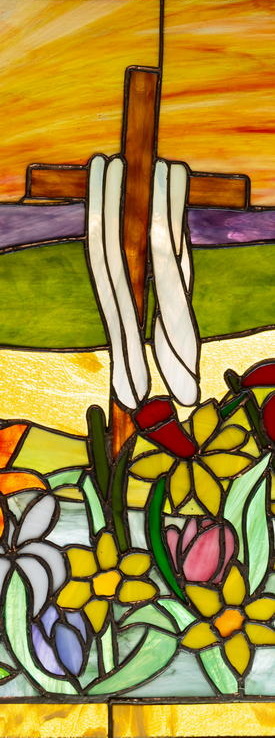
I preached this sermon on January 4, 20206, my first Sunday ever at Christ Presbyterian Church in Milford, Ohio. I was in the capacity of pulpit supply.
The lectionary text is John 1:(1-9,) 10-18 – The Word Became Flesh.
It’s the New Year! It’s a time for the annual ritual of renewal and resolutions, for well-intentioned promises and pledges, a hope for healthy habits. Born out of a desire for improvement are fresh beginnings.
Before the echoes of Auld Lang Syne fade away, people are headed to a packed gym. By Valentine’s Day, the treadmills are empty again. One trainer said, “I’ll still be here in March when you remember you have a gym membership.”
I struggle with New Year’s resolutions. I have little will power when it comes to temptations: food, new exercise routines, or otherwise. For example, I once finished a two-week diet in just three hours, 40 minutes! How do we embrace self-improvements when we’re too comfortable with how things already are? How do we embrace change?
Yet, we know the statistics. A quarter of resolutions fail in the first week, nearly half by the end of January. Why? Because they are often self-centered, relying on sheer willpower and a focus on temporary, superficial changes. We need help. [Repeat]
Twelve-step programs rely on God for strength to change. [SLIDE] You know the Serenity Prayer:
“God grant me the serenity to accept the things I cannot change;
Courage to change the things I can;
And wisdom to know the difference.”
Serenity, courage and wisdom – these are not just virtues we ask for, they are gifts from God, in the Holy Spirit.
The lectionary has us reading from the first chapter of John, so I think it’s appropriate for us to review why the Gospel of John was written and how it is different from the other three gospels. Matthew, Mark, and Luke have many parallels among them, so much so that they are called the Synoptic Gospels, meaning “Seen Together.” But 90% of John’s content is unique compared to the Synoptics, with a different focus.
The Synoptic Gospels focus more on Jesus’ life, teachings and actions, while the Gospel of John focuses on the divinity of Jesus, on *who* Jesus was and is. We see this in our reading today from the beginning.
John doesn’t have parables like the Synoptics do. Instead, John has its own unique stories and dialogues, like the resurrection of Lazarus, and theological conversations with Nicodemus and the Samaritan woman. John also doesn’t mention the Transfiguration. Why wouldn’t John mention one of the main milestones of Jesus’ life? Because for John, the Transfiguration wasn’t just a single event; it was the lens through which he saw every moment of Jesus’ life. Sneak preview: We’ll hear more about the Transfiguration in six weeks on Transfiguration Sunday, just before Lent.
Today’s reading is often called the Prologue to John’s Gospel: [SLIDE] 1 In the beginning was the Word, and the Word was with God, and the Word was God. 2 He was in the beginning with God.
“In the beginning” – does that sound familiar? Some would say John was quite audacious to rewrite the Creation Story from Genesis. But John is explicitly saying that Jesus was at the Creation, not being created, but as the Creator. Jesus is the Word.
Picture a king who can get things done just by speaking a word. That’s how God speaks in Genesis 1, ten times. God said, “Let there be light.” God said, “Let there be an expanse between the waters.” God said, “Let us make man in our image, in our likeness.” And so on. Creation hears the Word and obeys. The Word, God’s Word, created everything. Go to the other end of the Bible, where John repeats himself in Revelation 19:13, “And His name is the Word of God.”
John’s Gospel continues the creation theme today with light in verses three through five: [SLIDE] 3 All things came into being through him, and without him not one thing came into being. What has come into being 4 in him // was life, and the life was the light of all people. [SLIDE] 5 The light shines in the darkness, and the darkness did not overtake it.
We’re heading back to Genesis! Chapter 1:3, And God said, “Let there be light,” and there was light. God saw that the light was good, and he separated the light (good) from darkness (sin or evil). God called the light “day,” and the darkness he called “night.” But recall that in the Genesis Creation story, God didn’t create the Sun until the fourth day. God didn’t need the moon, stars or sun for light; He was the light. John reiterates this in his first letter, “God is Light and in him is no darkness at all.” (1 John 1:5)
Have you ever felt a sunrise, felt the power of light? I’m a long distance runner. I hope there are other runners here, or maybe you have a friend, family member who enjoys the benefits of distance running. I recommend our local Flying Pig Marathon or half marathon. I run mostly ultramarathons, which is anything longer than the standard 26.2 miles of a marathon. There are a lot of quotes that come from this extreme sport, including, “No one cares that you run ultras.” I downplay this activity and keep it out of the pulpit for the most part, except for the lessons it provides. “No one cares that you run ultras.”
100 miles is my favorite distance, and it takes me anywhere from 20 hours to 30 hours or longer to complete that distance. That usually means running overnight. I struggle to stay awake and moving in the darkness, wearing a hypnotizing headlamp and trying to find trail markings in the forest. By 5:00 AM, it’s the darkest and coldest, I’m 80 miles in, I’m exhausted, cold, sleepy, sapped of energy, and I have “miles to go before I sleep,” as the poet Robert Frost wrote.
But I know what’s about to happen on the second day; the pitch black sky starts to turn a little gray, the stars begin to fade, you see a definite brightening to the east. Then in a matter of just a few minutes, the darkness fades away, the sky becomes light, my energy is revitalized, my spirit renewed, I turn off my headlamp. When the sunlight brightens the sky on the second day, it’s like taking a Red Bull with an espresso chaser. Any runners near me start to brighten up as well, becoming more talkative and cheery, we all have more energy. The birds start to sing. We feel the power of light.
So there it is, verse 9, “The true light, which enlightens everyone, was coming into the world,” repeated more clearly, IMO, in John 8:12, Jesus said, “I am the light of the world. Whoever follows me will never walk in darkness, but will have the light of life.”
Continuing in John, we get to John’s unsentimental Christmas story, which is quite appropriate to share for the second Sunday in Christmastide [as we approach Epiphany]. Do you know where you find the story of the birth of Jesus? This is not a mystery or a quiz.
Some 15 years ago, our pastor was telling the children’s message at a Christmas Eve service. He was making the point that the story of Jesus’ birth is only in the Bible. He asked the kids, “Do you get the story of Jesus’ birth from ‘Frosty the Snowman?’” The kids all shout, “NO!” “Do you get it from ‘Rudolph the Red-Nosed Reindeer’?” The kids reply, “No!” The pastor asks, “Do you get it from ‘A Charlie Brown Christmas’?” The kids continued with their momentum, “No!”
If I could do a decent Linus imitation, I would have stood up, interrupted the pastor with, “Sure, Charlie Brown, I can tell you what Christmas is all about.” and recite Luke chapter 2, just like Linus did, in what has been called the most magical two minutes of TV animation. Do you remember that scene? “And the angel said unto them, Fear not:” Linus – very subtly – drops his beloved security blanket as he says, “Fear not.”
“That’s what Christmas is all about, Charlie Brown.”
Luke’s description is the well-known version used in stories and carols. Matthew has a short version of the story, including the visit by the magi [ma’-ji]. And the Christmas story does not even appear in Mark. [SLIDE] John’s gospel condenses the story into one verse: 14 And the Word became flesh and lived among us, and we have seen his glory, the glory as of a father’s only son, full of grace and truth. That’s it, no smelly shepherds or angels appearing or young mother, just one verse of the Messiah becoming man, dwelling with us, sharing our human experience, our struggles.
[SLIDE] John segues from his one-verse Christmas story to what Christ brings to us, his followers. 16 From his fullness we have all received, grace upon grace. 17 The law indeed was given through Moses; grace and truth came through Jesus Christ.
The Law was given through Moses (John 1:17). Don’t our resolutions often feel like a self-imposed law, a set of rules we create to govern our behavior? When we inevitably break them, we feel guilt and failure. We’ve let ourselves down and perhaps others close to us as well.
“But grace and truth came through Jesus Christ.” John mentions “grace” four times in his Gospel, and we heard all four mentions in this prologue. Grace is God’s unmerited favor. [Repeat] By definition, we don’t deserve grace. A resolution rooted in God’s grace is not about our performance, but His provision. It’s not about trying harder, but trusting deeper.
So this year, instead of making a self-centered resolution, relying on sheer willpower, [SLIDE] consider a single resolution: “I will seek to know and receive Jesus Christ more fully this year.” Feel free to add some metrics around it to make it a Smart goal. “I will seek to know and receive Jesus Christ more fully this year… By reading a book from the New Testament every week for the next 27 weeks, including an extra week to fully understand Revelation.”
Your resolution won’t fail // because it depends on the faithful and powerful One. It is an acknowledgment that He is the light – the source of serenity, courage and wisdom for true change. If you want to change your habits, your character, your future, start by receiving the One who makes all things new. You won’t fail in only three hours, 40 minutes.
Let us resolve to walk in His light, to receive His grace and truth, and to live not by the will of our flesh, but by the power of God. For from His fullness we have all received grace upon grace.
In Jesus’ name.