I preached this sermon on May 10, 2026 at Christ Presbyterian Church in Milford, Ohio.
The lectionary text is John 14:15-21, 26 – The Promise of the Holy Spirit.
Winnie-the-Pooh so eloquently said to Piglet, “How lucky I am to have something that makes saying goodbye so hard.”
Long goodbyes are hard. Sending our two sons off to college was among the hardest things Julie and I had ever done. We had a parent/child relationship with each of them for 18 years, watching them grow, nurturing them, teaching them what we could, giving them advice, supporting them in every way. We prepared them for years to leave the nest, to be adults.
Sending them off to college was a crowning moment in our careers as parents. We took them to countless music lessons, scout meetings, and sports practices. We taught them to drive, took them on college visits. They both accomplished more in high school than their parents, with a higher GPA.
We should have been strutting proudly as we took Philipp’s boxes up to the top floor of Fenn Tower on Euclid Avenue in Cleveland. We should have been joyous as we moved Erich into his second floor dorm suite in Bloomington. If you’ve been through this moment, you’ll agree with me that this milestone, while it should be celebratory for the parents, is a long goodbye: A “ta-ta” to toddlerhood, a “ciao” to childhood, an “adios” to their adolescence.
As we said our goodbyes, we sobbed. How lucky we were to have something that makes saying goodbye so hard. Julie and I would miss having them at home, even though we’d still get to see them on a now irregular basis.
I had penned a letter to each that I left behind, tucked under their pillow in their dorm rooms, a handwritten note that expressed my pride and my hopes that I had for them, last-minute advice, imploring them to call their mother, and expressions of love. They would read that letter that evening, extending the long goodbye. “Parting is such sweet sorrow,” Shakespeare said.
The Final Discourse in the gospel of John is Jesus’ long goodbye, that letter slipped under the pillow.
Last week’s, today’s, and next week’s gospel lessons are part of that Final Discourse in John. It is chapters 14-17, four chapters of nearly nonstop teaching or dialogue from Jesus. In my NIV study Bible, that is nearly all red lettering from Jesus talking.
The Final Discourse takes place the evening of the Last Supper, the betrayal, and the arrest the night before Jesus dies on the cross. Jesus is giving last minute instructions and guidance and revelations to his disciples. He’s running out of time, and as we see often, the disciples need to be told things two or three times. Jesus needs help, and it comes in the form of the Holy Spirit as The Paraclete. [ ]
I needed a graphic for today’s bulletin cover and I searched for Paraclete. Most of the graphics I found were that of a white dove. I was reminded of the cemetery service for Vickie Capurro that many of us attended where there were a dozen white doves released that sunny April morning. It was a beautiful experience, and it’s a beautiful image of those doves, flying back and forth a few times for us, for Vickie.
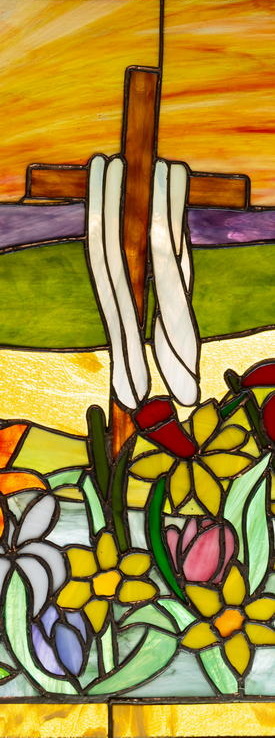
This week I was in the sanctuary what caught my eye? These beautiful stained glass windows, and the many times the Holy Spirit as a white dove shows up in them.
John tells more about the Holy Spirit in his gospel than the other three gospels combined. And he is the only writer in the New Testament to use the term Paraclete: four times in his gospel and once in his letter of 1 John. So it makes sense to look closely at his gospel to understand more about the Holy Spirit and that of the Paraclete.
Today’s scripture reading, like usual, has different Bible translations, but in this case, the variations actually help me understand John’s message.
The variations are all around the title “Advocate” that we heard used today in the NRSV translation. (The Advocate sounds like a John Grisham novel, doesn’t it? The Client, The Partner, The Firm, and now The Advocate. Available in hard cover on Amazon.) 16 And I will ask the Father, and he will give you another Advocate (or Paraclete), to be with you forever. The original Greek word that John uses is paraklētos, or the English form of the word, paraclete. It doesn’t translate well at all into English terms because it has a wide range of meanings in the Greek language. I looked at many different Bible translations and it seems there are as many different terms used as there are translations! For example, words that Paraclete were translated into are Advocate in today’s NRSV reading, Counselor in the NIV, Helper in the ESV, Comforter in the ASV, and intercessor. // Another phrase or description is “one who comes alongside.” I would say that the author meant ALL of these when he used ‘Paraclete’, referring to the Holy Spirit.
In a children’s sermon that I heard, the pastor asked the kids if they had heard of and understood the Trinity: the Father, Son and Holy Spirit, and the kids dutifully nodded their heads and said, “Yes!” The pastor said, “Good for you. There are some adults in this congregation who don’t understand it yet.”
I believe this is the third time I’ve referenced a children’s message in my own sermon. There’s some good material to be gleaned from them! I hope Paislee gets to hear some in this church.
But the Holy Spirit can be a difficult concept to understand. God the Father and God the Son are concepts we can grasp. We see the relationships in our families. How do we identify with the Holy Spirit that dwells among and within us? How do we grasp the concept like children do?
The view the scholars went with to describe a Paraclete is any person who helps another. They commonly use a lawyer to describe a Paraclete, one who advocates or intercedes. A Paraclete could also be a servant or a slave from the ancient days in the Bible. Or perhaps a pace group leader at last week’s Flying Pig Marathon. Any person who gives comfort, good advice, wise instruction, moral support, or help of any kind could be considered a Paraclete, according to John.
We look later in the gospel for other times that Paraclete is used, including today’s bonus verse 26, which clearly identifies who Jesus is referring and introducing to the disciples.“ 26But the Advocate (or Paraclete), the Holy Spirit, whom the Father will send in my name, will teach you everything and remind you of all that I have said to you.“ Jesus knew his earthly ministry was brief and about to end. He set the stage for the Paraclete to continue teaching and counseling the disciples.
(GOD)
I read and reread this passage, focusing on who was getting the Holy Spirit, and when. Who does John say Jesus is promising the Paraclete to? I’m reading that Jesus is promising the Holy Spirit as The Paraclete to dwell among and within the disciples in verses 16 and 26, and only the disciples. 16 And I will ask the Father, and he will give you another Advocate/Paraclete, to be with you forever. Note that Jesus says the Father will give you ANOTHER Paraclete, which we take as Jesus having been the Paraclete for his disciples all along; he was the first Paraclete.
So when does God send the Paraclete to the disciples? The Paraclete can be understood as Jesus’ replacement or successor as counselor and advocate and would be redundant if Jesus were still alive and teaching. Jesus tells the disciples later in the Final Discourse, in John 16:7, “But I tell you the truth: It is for your good that I am going away. Unless I go away, the Counselor/Paraclete will not come to you; but if I go, I will send him to you.” The Paraclete’s coming is directly related to Jesus’ going.// It is a direct consequence of Jesus completing the work of salvation and ascending into heaven.
On the evening of His resurrection, the day we call Easter, Jesus appeared to ten of the disciples (not Thomas) and finally breathed the Holy Spirit onto them. John 20: “21Again Jesus said, “Peace be with you! As the Father has sent me, I am sending you.” 22 And with that he breathed on them and said, “Receive the Holy Spirit.“
But still it was only the disciples received the Holy Spirit, not yet a widespread distribution to His believers, which would happen 50 days later on Pentecost.
*******************
Saying a Long Goodbye includes preparing for an absence, without them or without you. It’s sending a son or daughter off to college, graduating into adulthood. It’s navigating a terminal illness so you are prepared to hold the hand of your loved one as they take their final breath. It’s the gradual dimness of a parent suffering from dementia, regressing from adulthood.
You want to write that letter, place it under a pillow, leave your loved ones with comfort, good advice, wise instruction, moral support, to be their Paraclete.Jesus did that for us. In his Final Discourse, his Long Goodbye, he prepared us for his absence by introducing us to the Holy Spirit, our Paraclete, our letter under the pillow. Now go read it.